
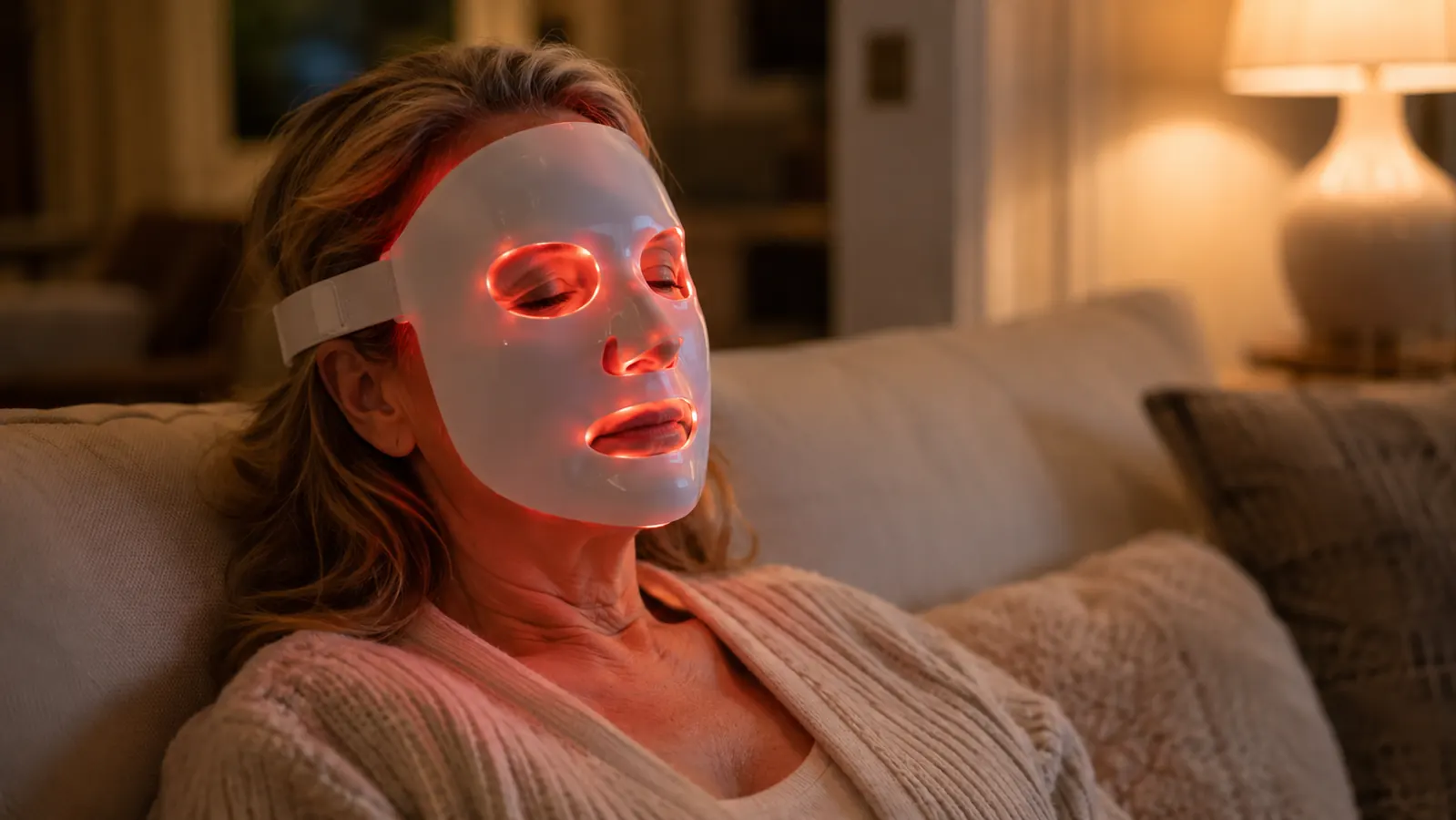
If you just bought an LED face mask, or you are still deciding, the first question is almost never about wavelengths or light counts. It is 'when am I supposed to wear this thing, and what goes on my face first?' I asked both of those questions myself before I tried the Shark CryoGlow LED Face Mask, and I am someone who spent thirty years looking at faces under a bright dental lamp. After eight weeks of using it a few evenings a week on the living-room couch, I can tell you exactly what worked, what did not matter, and what I wish someone had told me before I started.
The honest version is that most of the advice online is either too fussy or too vague. Some people say every day, some say a few times a week, and some people used it twice and let it live in a drawer. I have never been a fan of all-or-nothing routines. In thirty years of teaching people to care for their teeth, I learned that the best home care is the care a person will actually keep up. So this guide is not about being perfect. It is about building a mask routine that fits into a real evening, on a real couch, with a real life going on around you.
The LED mask that made it onto my couch, not into a drawer
The Shark CryoGlow LED Face Mask is rechargeable, hands-free, and the under-eye cooling is the reason I kept reaching for it. It holds a 4.4-star rating on Amazon with more than a thousand reviews, and it is the mask I use in the routine below.
Amazon Check Today's Price on Amazon →Step 1: Patch test on your jaw first, even if it feels silly
I know. Patch testing a mask sounds like the kind of advice that is technically correct and completely unnecessary. I felt the same way until years ago, when I tried a retinol too often too fast and spent two weeks with flaky skin around my nose. Now I patch test everything, including tools that sit on top of the skin instead of going into it. Your skin can react to the material, the padding, or even the way a mask traps warmth against your face, so the jaw is the place to find out before you commit to a full session.
To patch test, I held the mask against my clean jaw and the side of my neck for a short time, then waited a full day and checked for redness, itching, or anything that felt off. Nothing happened for me. The mask felt cool and comfortable from the very first session, and the under-eye cooling was the part I did not expect to love. But my skin is fairly easygoing these days, and yours may be more sensitive. If anything feels wrong during a patch test, that is the moment to stop and call a dermatologist, not the moment to push through and see what happens.
Someone needs to say the obvious thing: read the manual before the first session, not after. The manual and the app tell you the session times, and they are the same numbers I follow every time I use the mask. There is no prize for doing more than the instructions say. More is not better with a tool like this.
Step 2: Start with clean, dry skin and nothing underneath
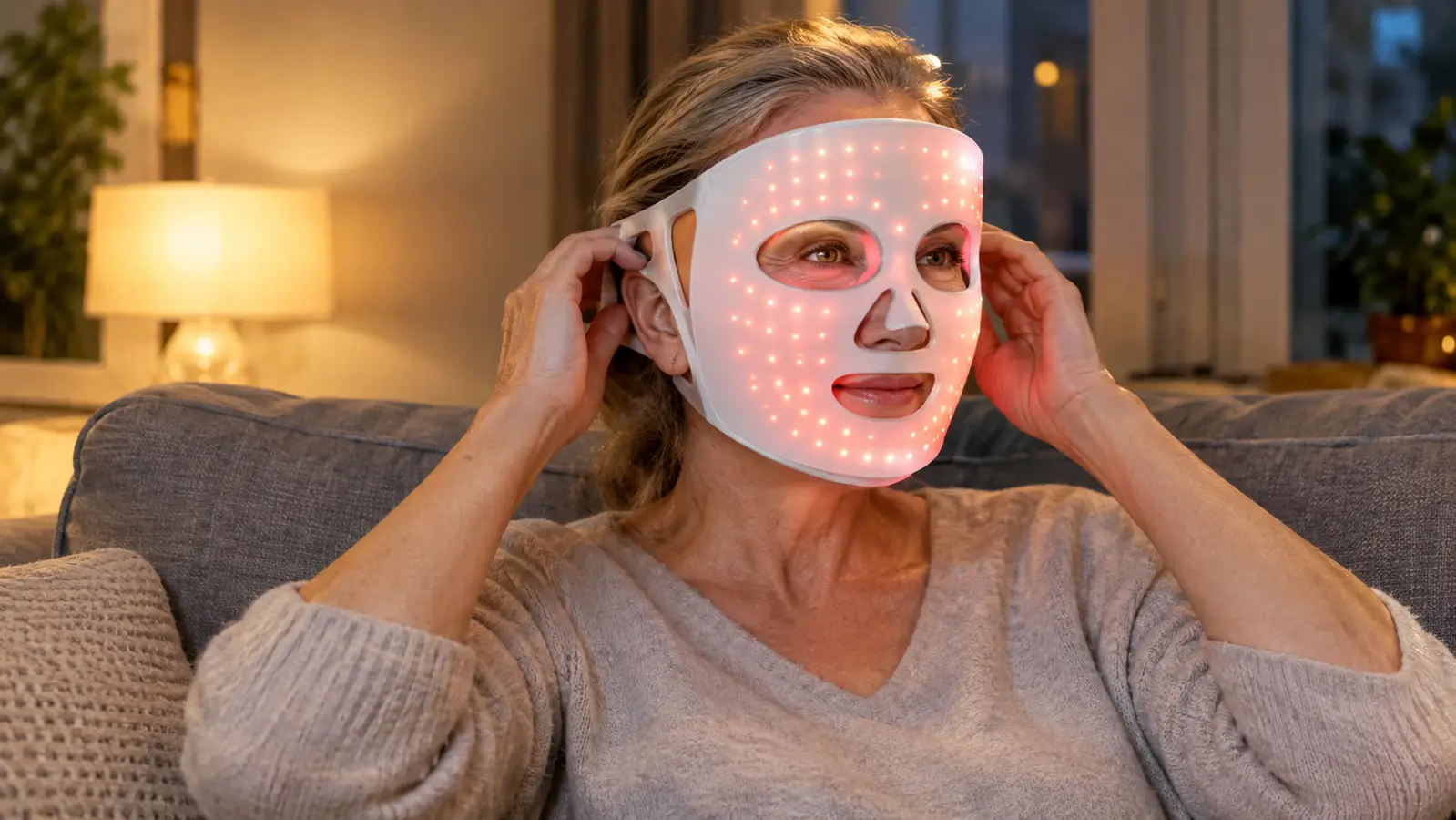
The Shark mask goes on clean, dry skin in the evening, before any serum. That order matters more than most people think. I wash my face with my usual gentle cream cleanser, pat it dry, and wait a minute so there is no dampness sitting on my skin. Then I put the mask on with nothing underneath. No moisturizer, no serum, no eye cream. The mask needs to sit against your skin, and anything you put on first just ends up pressed into your face for the whole session, which is not what the product is for.
This was the hardest habit for me to break, because my whole routine is built on layering products. It felt wrong to put nothing on. But once I got used to it, I realized the mask works best as the first step of the evening, not the middle step. After the session, I do my normal night routine. On retinol nights, that means the Olay Retinol Night Cream. On the other nights, it means The Ordinary copper peptides with my plain moisturizer. The mask never argues with any of those products, because it never meets them.
If you wear makeup, this step is even more important. The mask is not a cleansing device, and it is not going to do its job through a layer of foundation. Clean skin means clean skin. On evenings when I am too tired for the full routine, I still wash with my cream cleanser first, because the mask goes on clean skin or not at all. The goal is to make the good habit easy, not to make the perfect habit impossible.
Step 3: Wear it where you actually relax, not where you do chores
Here is the thing nobody tells you about an LED face mask: the hardest part is not the session. It is getting yourself to sit still for the session. If you have to stand at the bathroom sink or hold the mask in place with one hand, you will quit by the second week. The Shark CryoGlow is hands-free, which means you can wear it while you lean back on the couch and do absolutely nothing. I put mine on in the living room in the evening, usually while Dale watches something I am only half watching, without checking my phone.
I never set a strict schedule. The manual and the app give me the session times, and I follow those, but I do not count how many evenings a week I use it. Some weeks it is more, and some weeks life gets loud and it is less. The consistency that matters is that it happens at all, week after week. A few evenings a week on the couch beat a perfect plan that I abandon after the first month. That is the only rule I actually kept, and it is the reason the mask is still on my dresser.
Dale teases me about the mask, which I expected. He calls it my astronaut helmet, and I let him, because the alternative is that he asks me questions about it every single time I wear it. The teasing is worth it. There is something genuinely pleasant about sitting still for a little while with your eyes closed, feeling something cool against your under-eyes, and knowing you are not supposed to do anything else at that moment. For a former hygienist who spent decades on her feet, that is a small luxury.

Step 4: Follow the session, then clean and store the mask
During the session, I do not fiddle with the mask. I follow the session time in the manual and the app, I let the under-eye cooling do its work, and I close my eyes for part of it. I am a notebook person, so the app is mostly just where I check the session time. The mask is rechargeable, which means there is no cord to trip over while I wear it. That matters more than you would think. A mask that has to be plugged in while you wear it is a mask you will use less often.
After the session, I wipe the inside of the mask down gently, the way I would wipe any device that sits against my skin, and I put it back in its case on the bedroom dresser. Keeping it in the case does two things. It keeps dust off the part that touches my face, and it keeps the mask visible enough that I remember it exists. I learned that with other tools. If something lives in a drawer, it does not get used. The mask lives out in the open, and that is half the reason it became a habit.
One small note about the under-eye cooling, since it is the feature that surprised me most. It is the reason I reach for the mask on days when I am tired, and it is the part of the routine I would miss if it disappeared. It is not a treatment for anything, and I am not going to pretend it is. It just feels good, and a routine that feels good is a routine that survives. That is the whole argument for it.
Step 5: Take photos, keep notes, and know when to call a dermatologist
I kept the same habit I use for every product I test: dated photos in the same bathroom window light, and a notebook where I write down how my skin feels. After eight weeks of the mask, the change in my photos was modest and gradual. Mostly a more rested look around the eyes, which is exactly what the under-eye cooling felt like it was doing. There was no dramatic before-and-after, and I did not expect one. I trust slow, small changes more than I trust anyone who promises a transformation.
Here is the part I do not skip, even though it makes me sound like a cautious grandmother: an LED mask is a cosmetic tool, not a medical treatment. I am a retired dental hygienist, not a dermatologist. If you have a skin condition, if you have a history of skin cancer, if you have any redness or irritation that does not settle, or if you are simply worried about something on your skin, talk to a dermatologist before you add a mask to your routine. And talk to one again if anything changes while you use it. Your skin is not a science experiment, even when it is fun to try new things.
I will also tell you what I tell everyone who asks about any of the products on my shelf: one new thing at a time. If you are already trying a new serum or a new retinol, do not start the mask in the same week. You will not know which thing is doing what, and you will not know which thing to blame if something goes wrong. Let your skin settle into the mask for a few weeks before you change anything else. My daughter Lena, who lives in Seattle, is the one who first suggested the copper peptides I use on my non-retinol nights, and she is also the first to tease me when I add another gadget to the shelf. Patience is the least glamorous part of skincare, and it is also the most reliable one.
What Else Helps
An LED mask is one tool on a shelf full of them, and it works better when the rest of the routine is boring and dependable. My mornings start with TruSkin Vitamin C under a mineral SPF, because the SPF is the part that actually protects the work everything else is doing. At night I alternate between the Olay Retinol Night Cream and The Ordinary copper peptides, and I never put copper peptides and retinol on the same night. The mask slides into that routine on the evenings I use it, before the serum step, and it does not ask me to change anything else. That is why it stuck.
Storage matters more than it sounds like it should. My serums and the night cream live on the bathroom shelf above the sink. The vitamin C sits in the medicine cabinet, away from the window light, because it can darken in the bottle over time and I would rather it last. The mask lives in its case on the bedroom dresser. Everything has a place, and the places are easy to remember. When a routine has no friction, you do not have to decide whether to do it, you just do it. That is the real reason any of this works.
One more thing that helped me: I stopped expecting the mask to fix my skin and started treating it as a few quiet moments at the end of the day. The under-eye cooling genuinely feels good, especially in a dry Spokane winter when the heat has been running all day. When a habit feels like a small comfort instead of an assignment, you keep doing it. That, more than any feature, is why the Shark CryoGlow is still on my dresser instead of in a drawer, and why I would use it again tomorrow night.
Eight weeks of a few evenings a week, and my bathroom-mirror photos showed a more rested look around the eyes. Modest, gradual, and exactly the kind of result I trust.
The mask I would buy again, and I do not say that lightly
The Shark CryoGlow LED Face Mask holds a 4.4-star rating on Amazon with thousands of reviews, and my own eight weeks matched the general sentiment: a comfortable, hands-free mask that became an actual habit. If you want an evening routine that is easy to keep, this is the one to look at.
Amazon Check Today's Price on Amazon →